Foss

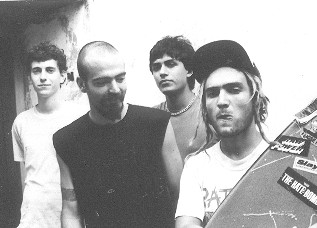
Foss was an American rock band formed in El Paso, Texas, in the early 1990s. Though their time together was short, Foss became a cult footnote in American punk history—partly because its members went on to wildly different paths. The lineup included Cedric Bixler-Zavala, later of At the Drive-In and The Mars Volta, and Beto O’Rourke, who would leave the DIY circuit for the political stage. Their sound blended post-hardcore urgency, emo introspection, and indie experimentation, while their story embodied the restless energy of the underground scenes that shaped them.
How The Band Got Started
El Paso in the 1980s wasn’t known for its music scene, but it gave rise to a generation of restless young punks looking for something new. Among them was Beto O’Rourke, an alienated teen who found belonging through the city’s small punk community. He hung out at the local DIY venue Campus Queen, where shows were run by Ed Ivey of the Rhythm Pigs. It was there that O’Rourke met Cedric Bixler-Zavala, who was performing in a Misfits cover band. Their friendship was instant, and O’Rourke’s enthusiasm for bands like Rites of Spring and Minor Threat helped shape Cedric’s early sense of musical purpose.
O’Rourke left El Paso to attend boarding school in Virginia and later Columbia University in New York, but he kept returning to El Paso to play shows and connect with friends in the scene. During one of those returns, he and Bixler-Zavala formed Foss along with Mike Stevens and Arlo Klahr. The band’s name came from the Icelandic word for “waterfall,” a fitting metaphor for their creative energy—fast, messy, and relentless.
Early Recordings and DIY Ethic
From the start, Foss embraced a DIY mindset. They formed their own label, Western Breed Records, and released their first 7-inch, The El Paso Pussycats, in 1993. The record featured O’Rourke on bass wearing a floral dress on the cover—a playful image that would resurface decades later during his political campaigns. The title, reportedly inspired by an abandoned television pilot about crime-fighting women, fit the band’s sarcastic, tongue-in-cheek style. Maggie Asfahani, O’Rourke’s girlfriend at the time, later revealed the dress was hers and the photo was simply a product of friends goofing around.
Foss’s music channeled the raw emotion of first-wave emo, the political intensity of Dischord Records acts, and the experimental tones of early indie rock. They drew heavy influence from Fugazi, Rites of Spring, and Dinosaur Jr., while Klahr brought in a taste for Australian and New Zealand punk bands like The Saints and The Clean. The mix resulted in a sound that was passionate, unpredictable, and unmistakably their own.
Tours and Chaos
Foss recorded a self-titled demo and the full-length album Fewel Street (often misspelled “Fewell” or “Fuell Street”) and hit the road for two North American tours. O’Rourke and Klahr booked the shows using the DIY directory Book Your Own Fucking Life, a bible for underground touring bands at the time. The band’s travel stories have since become the stuff of local legend. On one occasion, O’Rourke reportedly called a San Francisco venue pretending to be from Sub Pop Records to land a show slot; the ruse worked, but Foss was kicked offstage after two songs.
While touring, the band crossed paths with future stars like Leslie Feist, long before she became known as a solo artist and member of Broken Social Scene. These experiences gave Foss an early glimpse of how far DIY networks could stretch and how unpredictable the punk road could be.
The Infamous TV Appearance
One of Foss’s most notorious moments came in 1994, when they appeared on Let’s Get Real With Bill Lowrey, an evangelical public-access television show in El Paso. To secure a booking, the band told producers they were a Christian rock group. The result was chaos: the band thrashed through an improvised performance while bewildered hosts tried to keep order. Years later, clips of the broadcast resurfaced on YouTube, where it became a punk curiosity. Esquire called it “absolute chaos,” while The Dallas Morning News described it as “complete chaos” that made O’Rourke’s later political stage presence look tame by comparison. Even host Bill Lowrey later laughed about the incident, admitting, “They kind of pulled a fast one on me.”
Sound and Style
Critics and fans have described Foss as post-hardcore, emo-punk, and indie rock, depending on which tape they heard first. The song “Rise” from The El Paso Pussycats epitomizes their style—a lo-fi, urgent recording that feels halfway between Fugazi and Pavement. In 2018, Rolling Stone made “Rise” publicly available, calling it “lo-fi slacker rock” that captured the raw heart of early ’90s punk. Consequence of Sound described it as “a chalky slice of alternative rock that wouldn’t be out of place alongside Sunny Day Real Estate.”
The band’s ethos—self-recording, self-releasing, and self-booking—mirrored the DIY independence that would later shape O’Rourke’s approach to politics. His 2018 Senate campaign’s rejection of PAC money drew direct comparisons to his time with Foss, where “no intermediaries” was the guiding rule.
After Foss
Foss broke up in the mid-1990s, with O’Rourke admitting that he “wasn’t that good at” playing music and that his father pressured him to focus on his education. Afterward, O’Rourke joined several smaller projects, including Fragile Gang, The Swedes, and The Sheeps, and later co-founded the alt-weekly Stanton Street with former bandmate Mike Stevens. Bixler-Zavala, meanwhile, would soon form At the Drive-In and later The Mars Volta, both of which brought him international fame.
The first public mention of Foss after their breakup came via the webzine Buddyhead, around the time At the Drive-In released Relationship of Command in 2000. By then, Foss was already a small footnote in post-hardcore history, though their members’ later fame gave the band new life as a curiosity among collectors and fans.
Foss and Politics
When O’Rourke ran for U.S. Senate in 2018, Foss re-entered public consciousness. Articles in Spin, Pitchfork, and Texas Monthly revisited his punk roots, often referring to him as a “punk rock Democrat.” Many observers noted how his involvement in El Paso’s DIY punk scene gave him a sense of authenticity that appealed to younger voters. The Republican Party of Texas even mocked him on Twitter by posting the cover of The El Paso Pussycats with the caption, “Sorry, can’t debate. We have a gig.” The attempt at ridicule backfired, instead portraying O’Rourke as a relatable, unconventional candidate.
Former bandmates supported his campaign—Mike Stevens played an O’Rourke fundraiser with his current band, while Cedric Bixler-Zavala publicly endorsed him. Even so, the two would later clash politically, with Bixler-Zavala criticizing O’Rourke in 2020 for endorsing Joe Biden instead of Bernie Sanders.
Band Members
- Cedric Bixler-Zavala – drums, vocals
- Arlo Klahr – guitar, vocals
- Beto O’Rourke – bass guitar, vocals
- Mike Stevens – guitar, vocals
Discography
- The El Paso Pussycats (1993, Western Breed Records) – 7-inch EP featuring the song “Rise,” a lo-fi standout inspired by Fugazi and Rites of Spring.
- Foss (1993, self-released demo) – early recordings showcasing their raw post-hardcore beginnings.
- Fewel Street (1995, Western Breed Records) – full-length album blending punk energy with indie experimentation.
The Story After The Noise
Foss was more than a stepping stone for its members—it was a flashpoint in El Paso’s underground scene. They didn’t sell records by the thousands or headline festivals, but they helped spark a DIY culture that valued honesty over polish. Cedric Bixler-Zavala went on to reshape rock with The Mars Volta, and Beto O’Rourke took the lessons of independence and authenticity from the punk scene into politics. Foss remains a strange and fascinating bridge between two worlds that rarely collide: the noise of punk and the noise of democracy.