Dog Faced Hermans
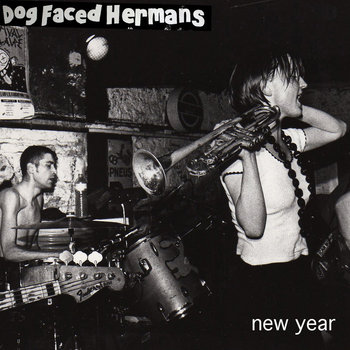
Dog Faced Hermans were a post-punk band from Scotland active in the mid 1980s through the mid 1990s. They emerged from the UK anarcho-punk movement with a guitar, bass, and drums foundation, but stood out by incorporating trumpet and other instruments not commonly used in punk at the time. Their compositions blended folk, jazz, ambient, and noise music, resulting in an experimental style with unorthodox instrumentation.
History
Formation and the 1980s
The band formed in Edinburgh out of the female-fronted funk-punk group Volunteer Slavery. Guitarist Andy Moor, originally studying anthropology, connected with Colin McLean over a shared love of free jazz, James Brown, reggae, and African music. Along with drummer Wilf Plum and trumpeter/vocalist Marion Coutts, the group began experimenting with improvised performances that often included banging on oil drums and scrap metal. The name Dog Faced Hermans came from a scene in an old horror film and quickly stuck.
Within a few years, the Hermans shifted from loose improvisations to more structured but still experimental songs. Their early releases on Demon Radge Records and Everett True’s Calculus label showcased their eclectic influences, including post-punk, no wave, and folk traditions. They even reinterpreted songs such as the Italian partisan anthem “Bella Ciao” and the American blues staple “John Henry.” During this period, they also recorded three songs for John Peel’s BBC Radio 1 show and appeared on UK television in 1988.
The 1990s and Collaborations
The Hermans formed a close alliance with Dutch anarchist band The Ex, touring Europe and North America together, collaborating on live releases, and even performing as a backing band for Kurdish musician Brader. In 1990, the band relocated to Amsterdam and welcomed The Ex’s sound engineer Gert-Jan as part of their circle. Andy Moor later became a permanent guitarist for The Ex while continuing to play with the Hermans.
Signed to Konkurrent Records, they released Mental Blocks for All Ages (1991) and Hum of Life (1993), the latter including a reworking of Ornette Coleman and 8 Eyed Spy songs. Their final studio album, Those Deep Buds (1994), came out on Alternative Tentacles, the label run by Jello Biafra. The group played their last concerts in San Francisco in October 1995 after nearly 450 gigs in a decade.
Post-Hermans
Following the breakup, members remained active in music and art. Wilf Plum went on to play in Rhythm Activism, Two Pin Din, and Orchestre Tout Puissant Marcel Duchamp. Andy Moor became a permanent member of The Ex and collaborated with numerous projects. Colin McLean continued touring with The Ex as a live engineer and bassist for collaborations with Ethiopian saxophonist Getatchew Mekuria. Marion Coutts focused on visual art and writing, while also briefly returning to music. Gert-Jan toured widely with The Ex and other bands such as Red Monkey and Zea.
Members
- Marion Coutts – vocals, trumpet, bells
- Colin McLean – bass, guitar, steel drum
- Wilf Plum – drums, scrap metal, foghorn
- Andy Moor – guitar, viola, “hippo tube”
- Gert-Jan – live sound
Discography
Studio Albums
- Humans Fly (1988, Calculus)
- Everyday Timebomb (1989, Vinyl Drip)
- Mental Blocks for All Ages (1991, Konkurrent/Project A Bomb)
- Humans Fly / Everyday Timebomb (1991, reissue)
- Hum of Life (1993, Konkurrent/Project A Bomb)
- Those Deep Buds (1994, Konkurrent/Alternative Tentacles)
Live Albums
- Live Action & Increasing (1988, Demon Radge)
- Live at the Ancienne Chocolaterie (1991, Demon Radge)
- Bump and Swing (1994, Konkurrent/Alternative Tentacles)
Singles
- “Unbend” (1987, Demon Radge)
- “Bella Ciao” / “Miss O’Grady” (1988, Calculus)
- “Too Much For The Red Ticker” / “Timebomb” (1989, Konkurrent)
- “Peace Warriors” (1993, Compulsive) – split with Jonestown