Discharge
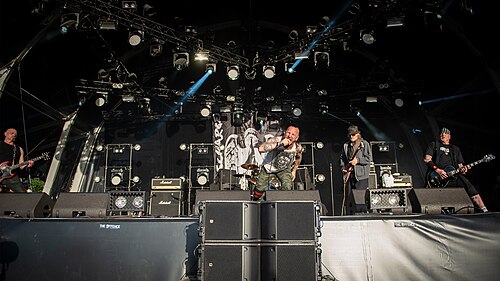
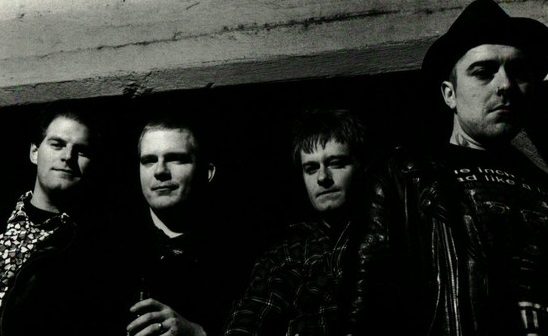
Discharge are an English hardcore punk band from Stoke-on-Trent, formed in 1977. Long before “D-beat” was a term, their onrushing drum pattern, scorched-earth guitars, and stark anti-war aesthetics reshaped punk and bled directly into emerging extremes of metal. Across decades, lineups, and stylistic detours, the group has remained a byword for speed, severity, and blunt political urgency.
Origins and early lineup
Discharge began in 1977 with Terence “Tezz” Roberts on vocals and Roy “Rainy” Wainwright on guitar, soon joined by Tezz’s brother Tony “Bones” Roberts on lead guitar, Nigel Bamford on bass, and Anthony “Akko” Axon on drums. Early sets reflected the first wave of UK punk, but the lineup shifted quickly: Axon and Bamford exited, Kelvin “Cal” Morris stepped in as vocalist, Tezz moved to drums, and Rainy shifted to bass. With this reconfiguration the band shed their Pistols-style attack for something faster, harsher, and far more minimal.
Sound, stance, and aesthetics
The new Discharge dispensed with melody in favor of raw, barked slogans over grinding, blown-out guitar and a lurching, relentless beat that would become known as D-beat. Lyrics were short, accusatory, and rooted in anarchist and pacifist themes: nuclear winter, state violence, militarism, and capitalist rot. Sleeves and flyers mirrored the content, repurposing stark black-and-white war photography and anti-fascist collage art to deliver the message without euphemism.
Breakout EPs and a definitive debut
Signing to Clay Records in 1980, Discharge issued a rapid run of singles and EPs that burned up the UK independent charts. “Realities of War” arrived first, followed by two more blasts that cemented the template. After a brief drum-chair shuffle ; Dave “Bambi” Ellesmere in, then out, with Garry Maloney taking over ; the group released the Why EP, their first indie number one. Those early sides made an immediate case for speed and severity as a political weapon, and pointed forward for hardcore, crust, thrash, and grind alike.
Key early releases
- Realities of War (1980) ; breakout single on Clay Records
- Why (1981) ; signature EP and UK indie number one
In 1982 the band delivered their landmark full-length Hear Nothing See Nothing Say Nothing, a brutal, compact statement that charted in the UK and routinely appears in all-time hardcore lists. Its impact crossed scenes: punks heard escalation, metal players heard permission.
Relentless gigging and global reach
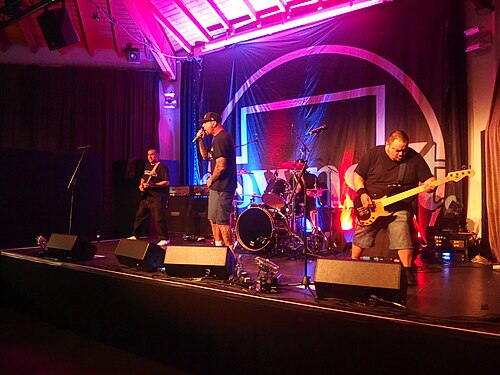
Constant touring with fellow UK punks GBH and The Exploited, and runs across Europe and North America, spread the Discharge approach internationally. Shows were short, volatile, and unsparing, with set lists stitched from two-minute detonations and minimal stage chatter.
Metal crossover years and first split
Guitarist change-ups in the mid-1980s pushed the sound toward overt metal. Peter “Pooch” Purtill’s arrival brought rock-informed leads, steadier tempos, and a shift in vocal delivery from Cal ; more sung, sometimes glam-tinged, while the rhythm section slowed to a stomp. The arc culminated in Grave New World (1986), a polished, mainstream-leaning metal record that hit the indie chart but divided their base. Instability followed, and the band dissolved in the late 1980s.
1990s return and heavy iterations
Cal reactivated Discharge in 1990 with a revised lineup and a harder-edged metal approach. Massacre Divine (1991) and Shootin’ Up the World (1993) paired rougher, gravelly vocals with weightier riffing and occasional thrash accents. Touring was extensive, including their lone trip to Japan, though reception varied as the band navigated new players and expectations. Activity tapered at the decade’s end.
Classic core reunites, then the Rat years
In 2001 the classic nucleus of Cal, Bones, and Rainy reconvened, issuing the self-titled Discharge in 2002. Its velocity and topical bite reconnected directly to their early catalog, albeit with traces of the metal heft they had accumulated. When Cal declined to tour, Anthony “Rat” Martin of The Varukers took the mic. The group released the single “The Beginning of the End” and the album Disensitise (2008), plus short-form releases in 2011 and 2012, before Rat’s tenure ended in 2014.
End of Days era and modern lineup
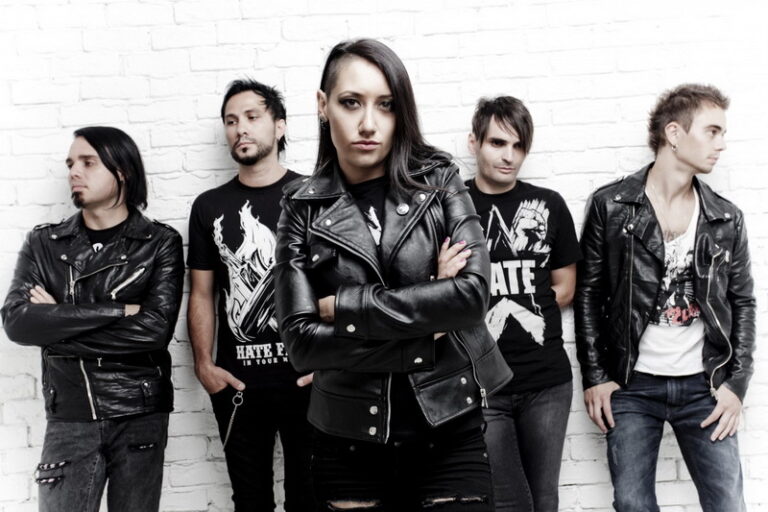
Vocalist Jeff “JJ” Janiak joined in 2014, with Tezz returning on rhythm guitar and Dave “Proper Caution” Bridgwood on drums, expanding Discharge to a five-piece. The stopgap New World Order EP teed up the full-length End of Days in 2016, issued by Nuclear Blast. Reviews highlighted the record’s live-wire production, piston-like D-beat, and gruff vocal barrage ; proof that the original formula still cut sharply. The album charted on UK rock and indie lists and fueled sustained touring in Europe and the United States, including a high-profile slot supporting the original Misfits in Los Angeles.
Influence and cross-scene impact
Discharge’s footprint stretches well beyond hardcore. Their tempo, drum pattern, and anti-war minimalism codified D-beat and seeded crust punk’s bleak realism. Thrash metal’s first wave absorbed the speed and monochrome aggression; grindcore’s founders lifted the structure and ferocity. Black and death metal auteurs cite the band’s reductionist power as a formative spark. Visual language and politics traveled too ; stark sleeves, anti-authoritarian sloganeering, and song titles that read like leaflets.
Styles shaped by Discharge
- D-beat and crust punk
- First-wave thrash metal
- Grindcore and extreme hardcore
- Black and death metal aesthetics of speed and bleakness
Artists known to cover or champion Discharge
- Metallica
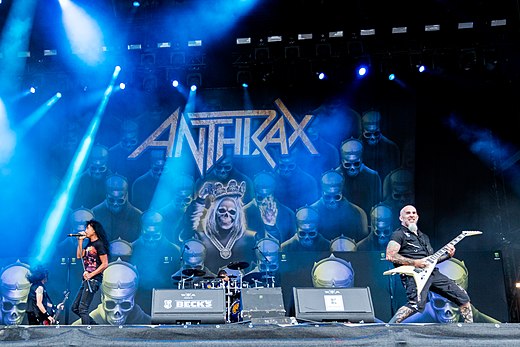
- Anthrax
- Sepultura
- Machine Head
- Arch Enemy
- Napalm Death
- Carpathian Forest
- From Ashes Rise
Notable cover versions
Generations of punk and metal bands have paid tribute by recording Discharge songs, underscoring how far the material travels across style lines.
Punk and hardcore interpretations
- Oi Polloi ; “State Violence, State Control”
- Mob 47 ; “Never Again”
- Nausea ; “Ain’t No Feeble Bastard” and “Hear Nothing, See Nothing, Say Nothing”
- Nasum ; “Visions of War”
- From Ashes Rise ; “Hell on Earth”
- Ensign ; “Protest and Survive”
Metal and extreme music versions
- Metallica ; “Free Speech for the Dumb” and “The More I See”
- Anthrax ; “Protest and Survive”
- Sepultura ; “A Look at Tomorrow,” “Hear Nothing See Nothing Say Nothing,” and “Protest and Survive”
- Machine Head ; “The Possibility of Life’s Destruction”
- Soulfly ; “Ain’t No Feeble Bastard” and “The Possibility of Life’s Destruction”
- Solstice ; “Protest and Survive”
- Carpathian Forest ; “The Possibilities of Life’s Destruction”
- Napalm Death ; “War’s No Fairytale”
- At the Gates ; “The Nightmare Continues”
- Monarch! ; “A Look at Tomorrow”
- Moss ; “Maimed and Slaughtered”
- The Meads of Asphodel ; “Hell on Earth” and “Blood Runs Red” medley
Members
Current lineup
- Terry “Tezz” Roberts ; guitar, former drums and early vocals
- Roy “Rainy” Wainwright ; bass
- Tony “Bones” Roberts ; guitar
- Dave “Proper Caution” Bridgwood ; drums
- Jeff “JJ” Janiak ; vocals
Album discography
- Hear Nothing See Nothing Say Nothing (1982)
- Grave New World (1986)
- Massacre Divine (1991)
- Shootin’ Up the World (1993)
- Discharge (2002)
- Disensitise (2008)
- End of Days (2016)
Selected themes and recurring imagery
- Anti-war, anti-nuclear messaging anchored in blunt slogans
- State power, police violence, and institutional cruelty
- Black-and-white photographic artwork with anti-fascist collage lineage
- Minimal song forms that privilege impact over ornament
Live presence and milestones
- Early 1980s UK indie chart runs off a string of EPs and singles
- Global touring across Europe, North America, and Japan
- High-profile 2017 appearance supporting the original Misfits in Los Angeles